
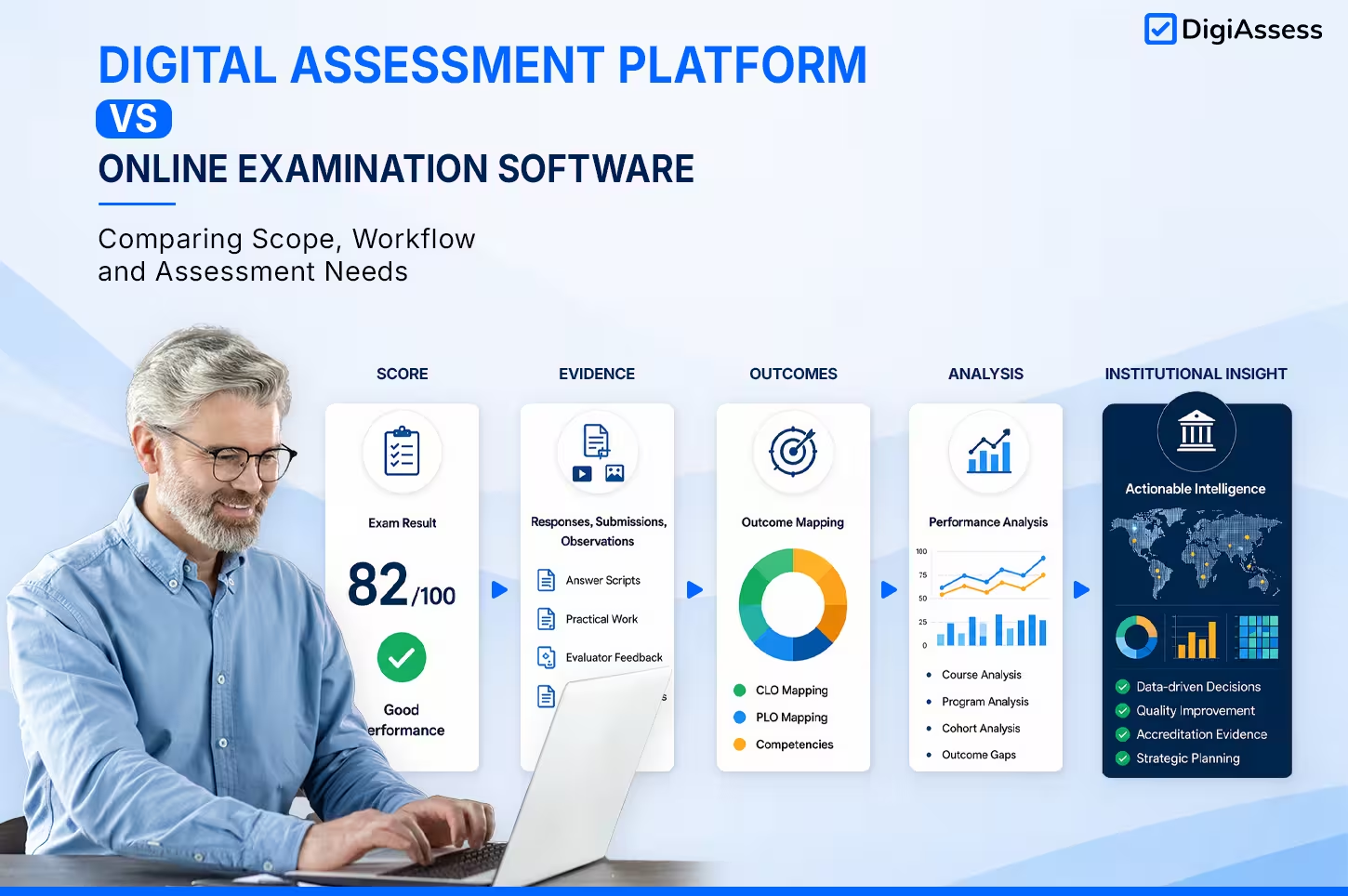
Universities increasingly use terms such as online examination software, online assessment platform, digital assessment software, and digital assessment platform interchangeably. While these technologies can overlap significantly, they do not always solve the same institutional problem. The difference is less about whether a system can conduct an examination online and more about how much of the assessment process the technology is designed to manage.
Online examination software typically concentrates on the examination event: creating the test, managing candidates, delivering questions, securing the session, evaluating responses, and generating results. A broader digital assessment platform may extend beyond that event into assessment design, multiple assessment formats, evaluation, analytics, learning outcomes, governance, quality assurance, and institutional reporting, depending on the platform.
This distinction matters when universities evaluate assessment technology because the right solution depends on the institution's assessment model. A university looking primarily to digitize examinations may need a different technology scope from an institution trying to connect assessment evidence across courses, programs, departments, and campuses.
Colleges and universities are modernizing assessment because they increasingly need to:
Assessment is evolving from an examination event into a broader source of institutional evidence.
Traditional systems can leave assessment data fragmented across departments, applications, and processes.
Digital exam delivery is only one part of assessment modernization.
Connected assessment links evidence with learning outcomes, competencies, programs, and institutional improvement.
Assessment intelligence can support academic quality, accreditation, governance, and continuous improvement.
The future of university assessment is not simply digital. It is connected, measurable, and strategic.
Dimension | Online Examination Software | Digital Assessment Platform |
Primary purpose | Digital examination delivery and administration | Broader assessment management |
Core workflow | Create → Schedule → Deliver → Evaluate → Result | Design → Configure → Deliver → Evaluate → Analyze → Improve |
Question management | Typically supported | Typically supported, with potentially broader governance |
Exam delivery | Core capability | Usually one component of the wider platform |
Security & proctoring | Often available | May support multiple assessment security models |
Evaluation | Usually exam-focused | May extend to different assessment and evaluation models |
Analytics | Often exam/candidate focused | May extend to item, course, program and outcome analysis |
Assessment formats | Primarily examinations and tests | Potentially exams, practical, clinical, competency, portfolio and workplace assessments |
Learning outcomes | May be limited | May support CLO, PLO and competency mapping |
Governance | Primarily examination administration | May extend to institutional assessment governance |
Accreditation evidence | Often requires additional processes | May support traceability and structured evidence |
Institutional scope | Often exam/session focused | Potentially institution-wide |
Best suited for | Focused digital examination requirements | Broader institutional assessment requirements |
This is a category-level comparison, not a universal product comparison. Some online examination systems have sophisticated security, offline delivery, proctoring, analytics, and operational controls. Likewise, the scope of digital assessment platforms varies between providers.
The important distinction is therefore scope and workflow, rather than simply feature count.
Online examination software is primarily designed to conduct examinations through digital environments. It brings examination creation, candidate management, scheduling, delivery, security, evaluation, and result generation into a technology-supported workflow.
For institutions whose primary requirement is to replace or complement traditional examination delivery, this can be a complete and highly capable technology category. A sophisticated online examination system may support remote and onsite examinations, offline continuity, BYOD environments, secure applications, identity verification, proctoring, and operational intervention.
The workflow generally begins with creating and configuring the examination. Administrators or faculty may define:
The sophistication varies by platform. Some systems are optimized for straightforward tests, while enterprise examination platforms may support complex examination structures and operational controls.
Question banks are another common capability. Questions can typically be stored and organized by subjects, topics, difficulty levels, question types, or other metadata.
Depending on the system, administrators may also create examination blueprints, randomize questions, generate different test forms, or apply selection rules. However, having a sophisticated question bank does not by itself make a product a broader digital assessment platform. Question management is a shared capability; the difference lies in what the institution can do with the assessment evidence around it.
Digital delivery is the core workflow of online examination software. Depending on the platform, students may take examinations through a browser, secure browser, dedicated application, institution-managed device, or BYOD environment.
Examly, for example, is documented as supporting remote online, remote offline, BYOD, and test-center examination environments, allowing institutions to adapt delivery to different connectivity and operational conditions.
This is an important distinction from the assumption that online examination software is simply a basic quiz system. Dedicated examination technology can address complex operational and security requirements while remaining primarily focused on exam execution.
For objective assessments, automated scoring can reduce manual marking and accelerate result generation. Depending on the platform, institutions may receive candidate scores, grades, question-level results, and examination reports.
These outputs are valuable for examination operations. But exam reporting and assessment intelligence are not necessarily the same thing. A score can tell an institution how a student performed in an examination, but it does not automatically explain how that performance relates to learning outcomes, competencies, curriculum objectives, or program-level improvement.
Security is a major requirement for high-stakes digital examinations. Online examination software may include authentication, secure examination environments, browser or application controls, webcam and screen monitoring, recorded proctoring, live proctoring, or AI-assisted monitoring.
Examly's source material describes physical invigilation, recorded proctoring, and live proctoring, alongside real-time monitoring, incident tracking, and intervention capabilities.
The important point is that advanced examination security does not automatically mean broader assessment management. Security protects the integrity of an assessment event. A broader assessment platform may additionally manage the academic and institutional processes surrounding that event.
A digital assessment platform operates at a potentially broader level. Instead of treating the examination as the complete assessment process, it can connect different stages of assessment and different forms of assessment evidence within a common environment.
Depending on the platform, this may include:
DigiAssess’s documented workflow illustrates this broader model by connecting institutional and academic structures with learning outcomes, assessment configuration, question-bank development, assessment delivery, evaluation, reporting, and outcome analysis.
Also Read: The Ultimate Guide to Digital Assessment Platforms
The simplest way to think about the distinction is:
Online examination software manages the examination. A broader digital assessment platform can manage the assessment ecosystem around the examination.
That distinction does not mean every platform supports every stage. It means the technology category is potentially broader in scope.
The two categories have substantial overlap. Both may provide question banks, exam creation, scheduling, candidate management, digital delivery, automated scoring, reporting, security, proctoring, and integrations.
This is why comparing them purely through a feature checklist can produce the wrong conclusion. Two systems may both offer question banks, proctoring, and analytics while being designed for very different institutional workflows.
Consider an examination office that needs to conduct a 5,000-student online examination. Both an advanced online examination system and a broader digital assessment platform may be capable of handling the event. The distinction becomes visible when the institution asks what happens before and after the examination.
A useful comparison therefore looks at five areas:
Scope
Does the technology primarily manage examinations, or multiple assessment activities?
Workflow
Does the process largely end with results, or does assessment data continue into evaluation, outcomes, analytics, and improvement?
Governance
Does the system manage examination administration, or can it also represent institutional assessment policies and controls?
Lifecycle
Does it support a specific assessment event, or a connected assessment lifecycle?
Institutional use case
Is the institution digitizing examinations, or building a connected assessment environment?
The difference becomes clearer when assessment extends beyond conventional examinations.
Universities rarely assess students through one method alone. Depending on the discipline, assessment may include written examinations, practical assessments, clinical examinations, portfolios, workplace-based assessments, projects, coursework, structured observations, and competency evaluations.
This is particularly relevant in professional education. Medicine and nursing, for example, may require practical or clinical evaluation alongside written examinations. Engineering may combine examinations with laboratory and project assessment. Other disciplines may rely on portfolios, presentations, case analysis, or workplace evidence.
A broader digital assessment platform can be relevant when these different assessment types need to be managed and analyzed within a connected environment. DigiAssess documentation, for example, identifies computer-based written examinations, paper-to-digital assessment, OSCE/OSPE, workplace-based assessment, readiness assessment, and portfolio-based evaluation within its broader assessment ecosystem.
The procurement question therefore changes from:
Can the system conduct our exams?
to:
Can the technology support the assessment models our institution actually uses?
Assessment governance addresses a different problem from exam security.
A university may have policies covering grading, reassessment, late entry, progression, approvals, assessment responsibilities, and other academic rules. As assessment operations become more complex, institutions may want those rules represented within their digital workflows rather than relying entirely on separate documents and manual processes.
DigiAssess's governance model includes configurable institutional assessment policies, scheduling governance, dynamic frameworks, multi-layer tagging, and traceability across assessment processes.
This creates a distinction between securing an examination and governing assessment.
Assessment evidence becomes more useful when it can be connected to what students are expected to learn.
Institutions using Outcome-Based Education may need to connect assessment items with Course Learning Outcomes (CLOs), Program Learning Outcomes (PLOs), competencies, or other institutional frameworks.
The goal is not simply to know that a student achieved a particular score. It is to understand what that performance indicates about learning and competency attainment.
DigiAssess documentation describes CLO and PLO mapping and the use of assessment results to analyze learning outcomes.
This capability can be particularly relevant when institutions need assessment evidence for curriculum review, outcome measurement, or accreditation processes.
The value of assessment data can extend beyond publishing results.
Academic teams may want to understand:
DigiAssess documentation describes item analysis, consolidated performance reporting, learning outcome analysis, individual student reports, progress reporting, and accreditation-related reporting.
This creates a meaningful distinction between exam reporting and assessment intelligence.
Exam reporting primarily answers:
What happened in this examination?
Assessment intelligence can help answer:
What does the assessment evidence tell us about learning and academic improvement?
Managing an examination is one operational activity. Managing assessment across departments, programs, campuses, assessment types, faculty, evaluators, and institutional frameworks is a larger institutional process.
At this level, universities may need centralized visibility across assessment preparation, scheduling, delivery, evaluation, outcomes, and reporting. DigiAssess documentation describes both centralized and decentralized assessment models, allowing institutions to determine how assessment responsibilities are distributed between central assessment teams and course-level instructors.
The technology requirement therefore changes as assessment becomes more distributed and complex.
A university does not necessarily have one assessment model.
Engineering may rely on examinations, laboratories, projects, and design work. Medicine may combine written examinations with clinical and practical assessments. Nursing may require structured competency evaluation. Law may use examinations alongside case analysis and coursework.
If assessment technology is selected only around the needs of conventional online examinations, other academic workflows may remain disconnected.
The better approach is to evaluate the institution's complete assessment portfolio, including the formats, governance processes, evidence requirements, and reporting needs that exist across programs.
A final grade is an important output, but it is not always the complete value of assessment.
Assessment evidence can also contribute to learning-outcome measurement, curriculum review, academic quality, accreditation, student improvement, and institutional decision-making.
This is where the broader assessment lifecycle becomes important. DigiAssess's documented workflow describes assessment moving from preparation and conduction into performance analysis and reporting, including item analysis, learning-outcome analysis, progress reporting, and accreditation-related reporting.
The distinction is therefore between recording an assessment result and using assessment evidence to generate institutional insight.
A university with one campus and a limited number of standardized examinations may have relatively straightforward technology requirements. A multi-campus institution managing thousands of students, different assessment formats, centralized policies, multiple test centers, and diverse academic programs faces a much more complex assessment environment.
At that point, institutions may need to consider centralized governance, scheduling, test-center operations, multiple delivery modes, analytics, integrations, and cross-program visibility.
Scale does not automatically mean a university needs a broader digital assessment platform. It means the institution should examine whether its current technology can support the complexity of its assessment operation without creating unnecessary fragmentation.
Online examination software may be entirely appropriate when the institution's primary requirement is secure and reliable digital examination delivery.
It can be a strong fit when:
There is no reason to adopt a broader platform simply because it contains more capabilities. If an institution's actual requirement is secure digital examination delivery, a capable online examination system may be the more focused and appropriate solution.
The broader category becomes more relevant when assessment has become an institution-wide academic process rather than an examination-office activity alone.
Consider a digital assessment platform when the institution needs to manage multiple assessment formats, connect assessment evidence to learning outcomes or competencies, establish centralized assessment governance, analyze performance beyond individual examinations, or support accreditation and quality-assurance processes.
Other signals include:
The strongest signal is not simply:
"We conduct a lot of exams."
It is:
"Our assessment processes have become complex enough that we need a connected environment to manage, understand, and govern them."
DigiAssess takes the broader approach to assessment technology by positioning assessment as an institutional ecosystem rather than only an examination event.
Its source documentation describes DigiAssess as a governance-first AI powered digital assessment platform for transforming assessments and observations into measurable evidence of learning, quality, and compliance.
The platform's documented workflow connects academic structures, learning outcomes, assessment configuration, question banks, examination preparation, delivery, evaluation, analytics, and reporting.
DigiAssess is documented as supporting a wider range of assessment contexts, including computer-based written examinations, paper-to-digital workflows, OSCE/OSPE, workplace-based assessment, readiness assessment, and portfolio-based evaluation.
This allows institutions to think about assessment as a collection of connected evidence rather than a series of isolated exams.
The platform's governance approach includes configurable institutional assessment policies, dynamic frameworks, multi-layer tagging, scheduling governance, and traceability.
The underlying idea is that institutional rules should not remain disconnected from assessment execution. Where supported by the implementation, policies and assessment frameworks can become part of the digital assessment workflow.
DigiAssess also connects assessment evidence with CLO/PLO mapping and outcome analysis. Its documented reporting capabilities include item analysis, student and cohort performance, learning-outcome analysis, progress reporting, and accreditation-related reports.
This gives the platform a broader role than simply generating examination results.
Within the DigiAssess ecosystem, Examly is positioned as a dedicated examination application focused on secure digital examination execution. It supports remote online, remote offline, BYOD, and test-center modes, alongside flexible proctoring and operational controls.
The relationship can therefore be understood as:
DigiAssess
→ Broader assessment ecosystem, governance, outcomes, evaluation, analytics, and institutional intelligence
Examly
→ Dedicated digital examination delivery application
This distinction reinforces the central comparison in this article. Examination delivery can be one layer of a broader digital assessment ecosystem rather than the entire assessment environment.
Also Read: Explore the DigiAssess Digital Assessment Platform
The answer depends on the institution's actual requirements.
|
If you need... |
Consider... |
|
Basic online examinations |
Online examination software |
|
Secure digital exam delivery |
Online examination software |
|
Automated scoring |
Online examination software |
|
Exam proctoring |
Online examination software or broader platform |
|
Multiple assessment formats |
Digital assessment platform |
|
Practical or clinical assessment |
Digital assessment platform, where supported |
|
CLO/PLO mapping |
Digital assessment platform |
|
Competency assessment |
Digital assessment platform |
|
Institution-wide assessment governance |
Digital assessment platform |
|
Program-level assessment intelligence |
Digital assessment platform |
|
Accreditation evidence and traceability |
Digital assessment platform, where supported |
|
Cross-campus assessment management |
Digital assessment platform |
|
Connected assessment lifecycle |
Digital assessment platform |
Before selecting either category, universities should evaluate:
Assessment complexity → How many different assessment models exist?
Institutional scale → How many programs, departments, campuses, and candidates are involved?
Governance → How much policy enforcement and auditability is required?
Academic requirements → Are CLOs, PLOs, competencies, or accreditation frameworks important?
Analytics → Is exam reporting enough, or is institution-level assessment intelligence required?
Integration → Does assessment need to connect with LMS, SIS, ERP, or quality systems?
The objective should not be to select the technology with the largest feature list.
It should be to select the technology category that matches the institution's assessment model.
Assessment technology can be viewed as an evolution:
Paper Examination
↓
Online Examination
↓
Digital Assessment
↓
Connected Assessment Intelligence
The first transition changed how examinations were delivered. The next expanded digital technology into different assessment activities. The emerging model connects assessment evidence with outcomes, analytics, governance, quality assurance, and continuous improvement.
That does not mean every university needs the most comprehensive platform available. A university with a straightforward requirement for secure online examinations may be well served by focused examination software.
But when assessment becomes distributed across programs, formats, outcomes, campuses, and institutional processes, the technology question changes.
The question is no longer simply:
"Can we conduct this examination online?"
It becomes:
"Can our assessment technology help us design, deliver, evaluate, govern, analyze, and improve assessment across the institution?"
That is the shift from online examination to connected assessment.
Assessment technology can be viewed as an evolution:
Paper Examination
↓
Online Examination
↓
Digital Assessment
↓
Connected Assessment Intelligence
The first transition changed how examinations were delivered. The next expanded digital technology into different assessment activities. The emerging model connects assessment evidence with outcomes, analytics, governance, quality assurance, and continuous improvement.
That does not mean every university needs the most comprehensive platform available. A university with a straightforward requirement for secure online examinations may be well served by focused examination software.
But when assessment becomes distributed across programs, formats, outcomes, campuses, and institutional processes, the technology question changes.
The question is no longer simply:
"Can we conduct this examination online?"
It becomes:
"Can our assessment technology help us design, deliver, evaluate, govern, analyze, and improve assessment across the institution?"
That is the shift from online examination to connected assessment.
They overlap, but they are not necessarily the same category.
Online examination software generally focuses on the examination event: creating assessments, managing candidates, delivering examinations, maintaining security, evaluating responses, and producing results.
A broader digital assessment platform may extend beyond that event into assessment design, multiple assessment formats, evaluation, analytics, learning outcomes, competency measurement, governance, quality assurance, and institutional reporting.
Neither category is automatically better.
If an institution primarily needs secure and reliable digital examinations, online examination software may be sufficient. If it needs to connect multiple assessment formats, learning outcomes, competencies, governance, analytics, and institutional evidence, a broader digital assessment platform may be a better fit.
The decision should therefore begin with the institution's assessment requirements, not with a vendor feature checklist.
The most useful question is:
What does our institution need its assessment technology to manage, measure, govern, and improve?
That question determines whether focused online examination software is sufficient or whether the institution needs the broader capabilities of a digital assessment platform.
Explore how DigiAssess approaches assessment as a connected institutional ecosystem.
Fill out the form to see how DigiAssess transforms academic operations