
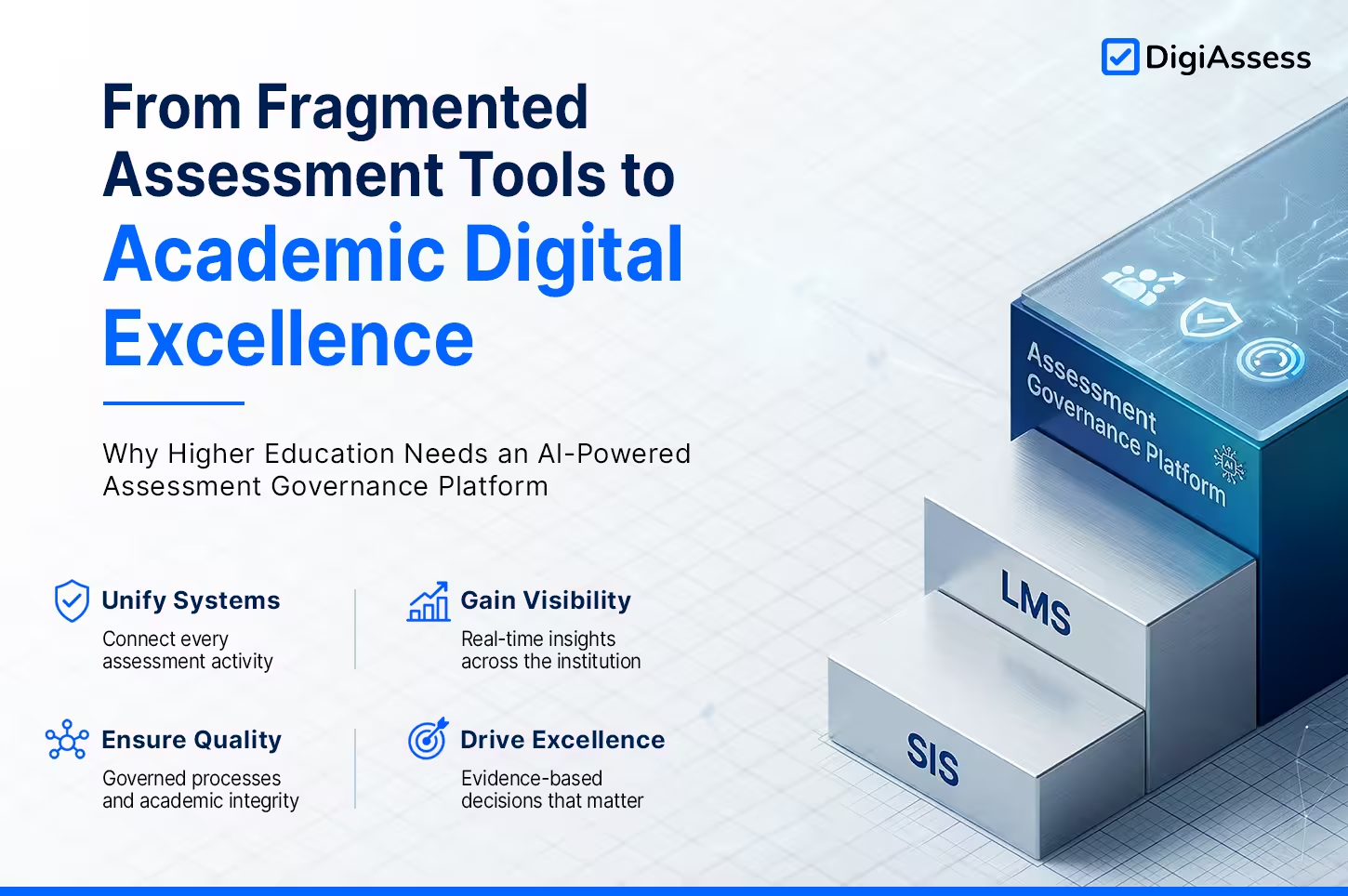
Higher education institutions now use multiple digital tools for teaching, assessment, examination, and proctoring. But when these systems operate independently, assessment workflows and evidence can remain fragmented.
Modern assessment goes beyond conducting exams. Institutions need to measure learning outcomes, track competencies, support different assessment formats, and generate evidence for academic quality and accreditation.
This is where an AI powered Assessment platform can move assessment beyond individual tools. By connecting planning, assessment design, scheduling, delivery, evaluation, outcomes, and reporting, institutions can create a more governed assessment environment.
In this article, we explore how institutions can move from fragmented assessment tools to an integrated assessment governance approach, and how this shift can support academic digital excellence.
The shift is not simply from paper to digital. It is from fragmented assessment tools to a connected digital assessment platform built around governance, evidence, and institutional visibility.
Colleges and universities are modernizing assessment because they increasingly need to:
Assessment is evolving from an examination event into a broader source of institutional evidence.
Traditional systems can leave assessment data fragmented across departments, applications, and processes.
Digital exam delivery is only one part of assessment modernization.
Connected assessment links evidence with learning outcomes, competencies, programs, and institutional improvement.
Assessment intelligence can support academic quality, accreditation, governance, and continuous improvement.
The future of university assessment is not simply digital. It is connected, measurable, and strategic.
Assessment is not simply the final step in teaching and learning. In modern higher education, it is the primary mechanism through which institutions determine whether learning has actually occurred. It enables institutions to measure learning outcomes, track competencies, and understand whether students are prepared for progression, professional practice, and employment.
As higher education moves toward outcome-based assessment and competency-based assessment, assessment has become increasingly important to institutional credibility. Accreditation expectations now require structured and measurable evidence of learning outcomes and competencies, making assessment a strategic institutional function rather than only an academic activity.
At the same time, assessment has become more complex. Institutions need to manage theory examinations, practical evaluations, clinical assessments, workplace-based learning, and hybrid delivery modes while maintaining consistency across departments, campuses, and assessment environments.
This creates five key dimensions of modern higher education assessment:
When these dimensions are not supported by a unified system, institutions increasingly depend on manual processes. This can lead to inconsistencies, delays, and greater operational burden, ultimately affecting the reliability of academic decisions.
Assessment, therefore, needs to be viewed not as an isolated exam event, but as a structured institutional process that connects learning, evidence, outcomes, and academic quality.
Most higher education institutions already rely on two core systems: a Student Information System (SIS) and a Learning Management System (LMS). The SIS manages structured academic information such as enrollment, progression, and transcripts, while the LMS supports teaching and learning activities.
However, these systems do not collectively manage the full institutional assessment lifecycle. Assessment may be conducted through the LMS or external tools, scheduling may depend on spreadsheets, outcome calculations may be performed manually, and accreditation evidence may be collected separately. Surveys, feedback, and competency tracking can also remain disconnected or only partially integrated.
The result is a fragmented assessment environment where individual components operate independently, while the institution lacks centralized control and visibility.
Assessment is often reduced to the act of conducting an examination. In reality, it is a continuous lifecycle that requires governance across multiple stages:
Outcome Definition & Curriculum Alignment
→ Assessment Design & Blueprinting
→ Scheduling & Coordination
→ Secure Execution
→ Evaluation & Moderation
→ Results & Feedback
→ Outcome & Competency Measurement
→ Reporting & Accreditation
→ Continuous Improvement
When these stages are managed separately, institutions lose visibility and control. Data becomes fragmented, workflows become inconsistent, and reporting becomes less reliable.
This gap between existing academic systems and the complete assessment lifecycle creates the need for a dedicated assessment governance layer within the academic digital ecosystem.
Modern institutions often rely on different technology layers to support different parts of assessment. LMS-based assessment tools support learning and course-level testing, standalone examination tools focus on secure exam delivery, and proctoring tools focus on monitoring and exam integrity. Each serves a specific purpose, but DigiAssess highlights a broader institutional gap: assessment requires governance across its complete lifecycle, from planning and execution to outcomes, reporting, and improvement.
The following comparisons examine where each type of tool fits within the assessment ecosystem and how an AI powered Assessment platform approaches the broader institutional requirement.
Learning Management Systems support teaching and learning through course-level activities such as quizzes and assignments. They are effective for learning delivery and instructor-led assessment, but their assessment capabilities typically operate within individual courses.
Institutional assessment extends beyond course-level quizzes. Higher education institutions need to manage assessments across programs and campuses, while supporting practical, clinical, workplace-based, and portfolio assessments.
Assessment also needs to connect with learning outcomes, competencies, accreditation frameworks, assessment policies, scheduling, and institutional reporting. Managing these requirements requires capabilities beyond the typical LMS assessment layer.
An AI powered Assessment platform operates at the institutional level, connecting assessment with the wider academic structure. It can support programs, levels, courses, and topics, along with CLO/PLO mapping, multi-framework mapping, taxonomy mapping, outcome version control, and assessment blueprinting.
This governance extends into assessment operations through centralized scheduling, conflict detection, test center management, role-based controls, governed question banks, review workflows, and blueprint-based paper generation.
Institutional assessment can span onsite, remote, hybrid, and low-connectivity environments. A governance-driven approach brings these delivery modes together with secure browsers, offline capabilities, live proctoring, AI monitoring, identity verification, and audit trails.
This allows assessment delivery and integrity processes to operate within a more controlled institutional framework.
Assessment governance does not end when an exam is completed. Structured evaluation, multi-evaluator workflows, re-evaluation, item analysis, CLO/PLO tracking, program-level reporting, accreditation reporting, and learning gap analysis extend assessment into outcomes and continuous improvement.
The focus shifts from simply recording scores to understanding what those results reveal about learning and performance.
An LMS-based assessment tool primarily supports learning delivery and course-level assessment. An AI powered Assessment platform operates at the institutional level, connecting assessment planning, design, execution, outcomes, reporting, and improvement within a governed environment.
The difference is not LMS versus assessment technology. It is course-level assessment versus institution-wide assessment governance.
Standalone examination tools are primarily designed for secure digital exam delivery. They can support written examinations, device control, and exam-related analytics. However, exam delivery represents only one part of the broader institutional assessment lifecycle.
An AI powered Assessment platform addresses a broader institutional requirement. Instead of focusing only on the examination event, it connects assessment planning, execution, evaluation, outcomes, reporting, and continuous improvement within one system.
This broader approach can support theory, practical, clinical, workplace-based, portfolio, paper-based, and external assessments within a unified assessment environment.
Assessment governance extends into the academic structure, connecting programs, years, levels, courses, and topics with learning outcomes and competencies. This includes CLO and PLO mapping, competency and EPA tracking, multi-framework mapping, taxonomy mapping, and outcome version control.
This creates a stronger connection between assessment activities and the outcomes and competencies institutions need to measure, rather than treating an examination as an isolated event.
Institutional policies can be incorporated into assessment workflows through configurable rules, policy enforcement, governance controls, audit trails, and centralized or distributed institutional control.
Assessment planning can also incorporate blueprinting, outcome and subject weightages, multiple assessment structures, content validity controls, and assessment integrity policies.
Institutional assessment requires coordination across schedules, test centers, seats, proctors, and other resources. An assessment governance platform can support centralized and automated scheduling, conflict detection, seat allocation, proctor assignment, and resource optimization.
This reduces dependence on manual coordination and spreadsheets while bringing assessment operations into a more structured workflow.
Assessment can be delivered across online, offline, and hybrid environments with capabilities such as secure browsers, multi-factor authentication, biometric authentication, AI monitoring, live monitoring, and real-time intervention.
After delivery, structured evaluation can include AI-assisted and rubric-based evaluation, multi-evaluator workflows, moderation, re-evaluation, instant results, structured feedback, and performance insights.
Assessment value extends beyond the final score. Real-time dashboards, CLO/PLO attainment reports, competency reports, accreditation reporting, custom reports, item analysis, institutional analytics, longitudinal tracking, and outcome-based improvement can help institutions understand assessment performance at multiple levels.
Integration with SIS, LMS, and quality assurance systems can further contribute to a unified academic data environment.
A standalone examination tool focuses primarily on secure exam delivery and session-level execution. An AI powered Assessment platform governs assessment as a complete institutional system, connecting policy, planning, execution, integrity, outcomes, competencies, accreditation, and continuous improvement.
The shift is from managing an examination event to governing the complete assessment lifecycle.
Proctoring tools primarily focus on monitoring student behaviour during examinations. They typically support capabilities such as webcam recording, browser lockdown, and AI-based identification of potentially suspicious activity. While these capabilities strengthen exam integrity, proctoring addresses one part of the wider assessment process.
An AI powered Assessment platform treats proctoring as one component of a broader assessment governance framework. Monitoring, intervention, policy enforcement, audit, reporting, and outcomes can operate within the same institutional workflow.
The distinction is straightforward:
Proctoring tools monitor exams. An AI powered Assessment platform governs assessments.
Assessment governance can extend integrity controls beyond simply recording or flagging activity. During an assessment, institutions can manage situations through actions such as pausing an exam, extending time, resetting attempts, re-authentication, and allowing re-entry.
These controls can operate within defined institutional policies, allowing proctors and administrators to respond to assessment events while maintaining a traceable process.
Traditional proctoring is primarily focused on identifying and recording potentially suspicious behaviour. A governance-driven approach connects detection with decision-making and policy-based action.
Real-time violation detection, actionable alerts, structured incident handling, and activity logs covering student actions, proctor actions, timestamps, and system events provide greater visibility for institutional review and audit.
The governance layer extends beyond an individual examination session. It can support centralized oversight across programs, campuses, proctors, coordinators, and administrators.
Proctoring activity can also be connected with assessment performance and outcomes, supporting assessment analytics, institutional reporting, and accreditation readiness.
Assessment is not limited to remote examinations. A broader governance environment can support onsite, remote, hybrid, practical, clinical, and structured assessments, including OSCE and OSPE.
It can also accommodate operational requirements such as late entry, re-authentication, reassignment, and assessment resets, helping institutions manage exceptions within a controlled workflow.
A proctoring tool addresses the specific requirement of exam monitoring. An AI powered Assessment platform embeds assessment integrity within the wider lifecycle, connecting monitoring with intervention, policy, audit, outcomes, reporting, and institutional governance.
The shift is from monitoring an exam to governing assessment integrity as part of the complete institutional assessment process.
LMS quizzes, standalone examination tools, and proctoring solutions each address a specific part of assessment. LMS tools support learning and basic testing, examination tools enable secure exam delivery, and proctoring tools monitor student behaviour. Individually, these tools are useful. But collectively, they do not fully address assessment as an institutional function.
Institutional assessment is a continuous, governed lifecycle that extends across planning, policy enforcement, scheduling, secure execution, evaluation, outcome measurement, and accreditation reporting. When these activities are distributed across multiple systems, institutions often have to manage the resulting complexity through manual processes, spreadsheets, and fragmented data.
DigiAssess is designed as an AI powered Assessment platform that brings the assessment lifecycle together within a unified system rather than adding another standalone tool.
It brings together:
The transformation is structural rather than incremental.
Multiple tools → One system
Manual coordination → Reduced manual workload
Data silos → A reliable source of truth
Delayed reporting → Real-time visibility
Operational burden → Strategic capability
The goal is not simply to add another technology layer. It is to create a governed assessment environment where the different stages of the assessment lifecycle operate as part of one connected system.
The choice is not simply between different assessment tools. It is between continuing with fragmented processes or moving toward a governed, intelligent assessment system.
For institutions, this means shifting from managing assessment complexity to governing assessment with clarity, control, and confidence.
This is where an assessment governance platform becomes a structural layer within the academic digital ecosystem, connecting assessment activities with outcomes, evidence, and institutional decision-making.
The challenge facing higher education institutions is not the absence of assessment tools. It is the absence of a unified system that can govern assessment as a critical academic function.
An assessment governance platform provides this missing layer. It does not replace existing systems such as the SIS or LMS. Instead, it connects them and brings assessment into a single, policy-driven environment where the complete lifecycle can be governed, measured, and improved.
Without these foundations, assessment remains fragmented and largely marks-based.
These capabilities are essential for maintaining consistency, data continuity, and institutional control.
These capabilities determine how consistently assessment can be designed and executed at scale.
The goal is to turn assessment information into assessment intelligence that can support academic decision-making.
Finally, can the system support feedback loops, performance tracking, decision-making, AI-driven automation, paperless operations, institutional intelligence, resilience, and leadership-level insights?
These questions determine whether an institution is simply using digital tools or building a more governed and intelligent assessment environment.
The fundamental test is simple: Can the institution govern assessment as one connected system, rather than manage it through multiple disconnected processes?
The challenge facing higher education institutions is not the absence of assessment tools. It is the absence of a unified system that can govern assessment as a critical academic function.
An assessment governance platform provides this missing layer. It does not replace existing systems such as the SIS or LMS. Instead, it connects them and brings assessment into a single, policy-driven environment where the complete lifecycle can be governed, measured, and improved.
Assessment governance begins with assessment design and extends through execution, evaluation, outcomes, reporting, and accreditation. By connecting these stages, institutions can reduce fragmentation and maintain greater visibility across the assessment lifecycle.
Institutional policies can be embedded into assessment workflows rather than managed separately through manual processes. This enables rules to be applied consistently across departments and campuses while supporting institutional control and auditability.
Assessment data can be brought together across the academic ecosystem, creating a single source of truth. Integration across SIS, LMS, and quality assurance systems helps maintain data continuity and reduces fragmentation.
Assessment becomes more meaningful when results are connected to learning outcomes and competencies. Real-time CLO, PLO, and competency tracking enables institutions to move beyond marks and evaluate measurable academic outcomes.
Assessment operations can be structured through automated scheduling, allocation, and reporting. This reduces manual workload and helps institutions manage assessment processes more consistently across their academic environment.
An AI powered Assessment platform can turn assessment data into insights about student performance and learning gaps. This supports more informed predictive and prescriptive decision-making and helps assessment become a proactive part of academic improvement.
With an assessment governance platform, processes that previously depended on manual coordination can become structured and automated. Fragmented data can become unified and reliable, while assessment can evolve from a reactive operational activity into an institutional capability that supports quality, consistency, and long-term academic excellence.
Higher education institutions ultimately aim to produce graduates who are knowledgeable, competent, and prepared to contribute meaningfully to society. Achieving this depends on the institution’s ability to measure learning outcomes and competencies accurately and consistently. Assessment is the mechanism through which this measurement takes place.
Fragmented assessment processes give institutions only partial visibility. Decisions may depend on incomplete or delayed data, while learning outcomes and competencies can be difficult to validate systematically.
This affects not only academic processes but also the credibility of institutional decisions and evidence.
When assessment is governed through a connected system, institutions can measure learning in real time, track competencies across programs, and generate reliable evidence for accreditation and decision-making.
Assessment becomes more structured, transparent, and intelligence-driven, creating a foundation for continuous improvement.
Academic Digital Excellence depends on five connected capabilities:
1. Unified Academic Ecosystem
SIS, LMS, and the assessment layer working together.
2. Real-Time Outcome Measurement
Continuous tracking of learning outcomes and competencies.
3. Evidence-Based Decision-Making
Reliable assessment data supporting academic strategy.
4. Consistency and Governance
Standardized assessment processes across the institution.
5. Integrated Intelligence
Insights connecting performance, quality, and improvement.
Academic Digital Excellence is therefore not achieved through isolated tools. It emerges when the components of the academic ecosystem function as a unified whole, with assessment connecting learning activities to measurable outcomes and institutional intelligence.
The transformation is clear:
Fragmented processes → Unified governance
Delayed reporting → Real-time intelligence
Assumptions about learning → Measurable evidence of outcomes and competencies
When assessment is governed, learning becomes measurable. When learning becomes measurable, quality can be assured, creating a stronger foundation for producing competent, confident, and employable graduates.
Choosing an AI powered Assessment platform should go beyond comparing individual features. The more important question is whether the platform can support the institution’s complete assessment requirements, from academic structure and assessment design to delivery, outcomes, reporting, and continuous improvement.
Institutions should first consider whether the platform can support different assessment types, academic structures, learning outcomes, competencies, and outcome frameworks across programs and campuses.
The platform should support assessment policy digitization, policy enforcement, integration with SIS and LMS, cybersecurity, and centralized or distributed institutional control. These capabilities help establish consistency across the assessment environment.
Assessment quality also depends on blueprinting, governed question banks, scheduling, resource allocation, secure delivery, and structured evaluation. Institutions should consider whether these processes can be managed within a connected workflow rather than through separate tools and manual coordination.
Assessment should produce more than scores. Institutions should look for assessment analytics, meaningful reporting, unified data, outcome and competency measurement, and mechanisms that support continuous improvement.
An AI powered Assessment platform should also support institutional scalability, AI-driven capabilities, paper and digital assessment environments, decision support, resilience, and leadership-level intelligence.
Ultimately, the right platform should help institutions answer a simple question:
Can we govern assessment as one connected institutional system rather than manage it through multiple disconnected processes?
The guide provides a deeper look at the assessment governance model, technology comparisons, and the questions institutions should consider when evaluating their assessment environment.
Fill out the form to download the DigiAssess Complete Assessment Governance Guide